
My prediction
More possibilities. A growing need to understand each other.
Want to know how I imagine the future of AI? Ever more power, content and ideas. And, at some point, a growing need to hear each other’s voices and look each other in the eye.
The transformation began long before generative AI. From printed books to digital content, from pen-and-paper notes to tablets, from classrooms to distance learning at online universities: the ways we access, organise and interact with information have changed.
How much is our ability to learn changing too?
This is where I make my prediction: we may be able to train ourselves to recognise connections and understand complex content more quickly. A hypothesis to test, while continuing to question, experiment and reason.
Two open questions
Learning better. Seeking each other out.
A — Learning. Active, guided practice in environments that combine different tools could improve the organisation of knowledge and the recognition of relationships within specific domains. Outcomes may depend on experience, activities and instructional design. The more ambitious prediction concerns speed: we might understand complex content faster. This must be tested while holding comprehension, retention and subsequent application at an equivalent level.
B — Human connection. If content production grows faster than the time available to consider it, people and organisations may place greater value on direct dialogue and responsibility for decisions. This social prediction does not necessarily follow from hypothesis A: we could learn better without meeting more often, or seek more connection without any cognitive improvement.
“We Will Embrace Again” remains the title of the vision and its human conclusion. The two hypotheses make the intermediate steps testable.
The wider transformation
Tools and environments that coexist
1988 refers to Sweller’s work on cognitive load. It does not mark the beginning of technology in learning. Different media continue to coexist and should be studied in combination.

Printed books and digital content
Reading the same text on different media, following links, finding passages and integrating audio and images are different activities.
The meta-analysis by Delgado and colleagues finds an average advantage for paper in the comprehension of comparable texts, moderated by factors including time pressure and text genre. It does not suggest that familiarity with screens automatically removes disadvantages, nor does it represent every possible digital learning experience. [3]
Mayer and Moreno already addressed the relationship between verbal and visual representations, limited capacity and active processing in multimedia learning. This is an essential theoretical link for understanding the transformation that preceded generative AI. [4]
Question: which ways of reading, navigating and integrating sources support deep understanding beyond quick access?
Paper, pen, keyboard and tablet
Distinguish handwriting on paper, writing with a digital pen and typing. Also separate transcription, summarising, drawing diagrams and reworking notes.
Urry and colleagues did not confirm a robust handwriting advantage for immediate learning in the situation they studied: taking notes during a lecture, followed by a quiz without review. This result does not cover every possible use of these media. [5]
Van der Weel and Van der Meer report differences in EEG connectivity during writing with a digital pen and typing in 36 university students. The study measures brain activity during the task; it does not, on its own, demonstrate better understanding or lasting recall. It also shows why “handwritten” and “digital” can coexist. [6]
Question: which combination of movement, information selection and reworking helps build usable knowledge?
Classrooms, distance learning and online universities
Access, locations, timing, opportunities to replay lectures, tutoring and autonomy all change. A recording, a live discussion and a course with individual feedback do not constitute a single “online” condition.
The synthesis by Means and colleagues found favourable outcomes in some online and especially blended conditions, while noting differences in learning time and resources between groups. The medium did not necessarily explain the advantage. This is a historical reference, not an assessment of contemporary Italian online universities. [7]
For the latter, specific comparisons would be needed, accounting for prior preparation, age, employment status, subject, tutoring, equivalent assessments and dropout. Grades or satisfaction alone do not isolate the effect of the teaching format.
Question: which forms of flexibility, interaction and support help learning, and for which students?
Information searches and interaction with AI
Generative AI adds explanations and content produced in response to requests. Its educational role also depends on the activities it encourages.
Bastani and colleagues’ trial in school mathematics distinguishes a general-purpose interface from a tutor with instructional guardrails. Better performance during assisted practice did not guarantee independent learning: the general-purpose condition showed disadvantages when support was removed, which were mitigated in the guided condition. [8]
Kestin and colleagues, by contrast, report favourable results for a tutor designed for learning compared with active classroom teaching, on university physics content and assessments close to the lessons. They do not demonstrate a general, lasting advantage across all subjects. [9]
Question: which activities does the tool prompt the person to carry out, and which does it do on their behalf? What remains without support?

Explore the scientific foundations
The foundations of the argument.
The limits of the evidence.
These studies and theoretical frameworks help formulate the questions. On their own, they do not demonstrate a general increase in cognitive abilities or a future return to meeting in person.
Cognitive load theory continued to develop after 1988. The issue is to test how its principles describe today’s combinations of tools, activities and knowledge.
Neuroplasticity
Training studies, including the work of Draganski and colleagues, support the possibility of experience-related changes in the brain. They do not justify concluding that more content increases our general capacity to learn or that every adaptation is beneficial. [10]
Chunking
Chase and Simon studied experience-related patterns in chess. Their work supports the role of domain-specific knowledge in organising information; transfer to other content requires testing. [11]
Long-term working memory
Ericsson and Kintsch propose a framework in which knowledge and retrieval structures make useful information accessible to experts. This is not equivalent to an unlimited general capacity. [12]
Cognitive load
Sweller’s 1988 work addresses task demands and schema acquisition. The theory has continued to develop, as documented by the 2019 review. [13], [14] The question is which predictions remain appropriate for today’s combinations of tools and activities, and which data call for further revisions. The passage of time alone does not demonstrate that the theory is inadequate.
Cognitive offloading
Notes, reminders and external aids can redistribute the cognitive work required by a task. Risko and Gilbert study the reasons for, and consequences of, this delegation.
Reducing immediate effort does not guarantee that the required knowledge has been learned. Risko and Gilbert, 2016 [2]
Multimedia learning
Mayer and Moreno connect verbal and visual representations, limited capacity and active processing: a useful framework for designing materials that help build connections.
Adding images, audio or interaction does not guarantee an advantage: design matters. Mayer and Moreno, 2003 [4]
What does “truly learning” mean?
Completing a task with assistance, remembering over time and applying what has been learned to a new problem are different outcomes.
| Outcome | Question | Possible measure |
|---|---|---|
| Assisted performance | What can I do with support? | Accuracy and time with tools available |
| Lasting learning | What remains after studying? | Delayed comprehension and recall without assistance |
| Application to new cases | Can I use what I have learned on a different problem? | New tasks, distinguishing close variations from distant domains |
| Awareness of limitations | Do I recognise what I have not understood? | Gap between reported confidence and accuracy |
| General cognitive abilities | Has an ability changed beyond the trained domain? | Multiple validated tests, controls and repeated observations |
In 1991, Salomon, Perkins and Globerson already distinguished effects achieved with a technology from those that persist after its use. This theoretical reference connects the whole historical journey. [1]
Risko and Gilbert describe cognitive offloading: using actions and external aids to reduce a task’s cognitive demands. This framework helps investigate notes, reminders and digital tools; it does not establish that every form of delegation improves or worsens learning. [2]
Time · Choice · Responsibility
Then we will face the limits of time.
We will not be able to discuss every idea, watch every presentation, use every app or read every message we can generate. Even with AI, each day will still have twenty-four hours.
Faced with yet another perfectly packaged proposal, we will say: “Now I decide.” With the responsibility to choose and accept the consequences.
“Shall we talk? Shall we meet? I want to understand what you really think!”
Limited time motivates the question of selection, but does not prove that we will prioritise relationships. Greater automated delegation, avoidance and disengagement are also possible.
“Now I Decide” expresses the author’s position: retaining responsibility for criteria, checks and consequences. This can translate into observable behaviours: explaining a choice, seeking objections and documenting why one changes one’s mind.
Kumar and Epley find greater social connection, under the conditions studied, in interactions involving voice than in written exchanges. This result does not verify a future return to meeting in person caused by digitalisation. [15]
Feeling close, understanding a problem and making a sound decision are distinct outcomes. In this proposal, useful dialogue includes checking information and the freedom to disagree. The embrace represents the human conclusion of the vision; measures would concern voluntary engagement in dialogue, perceived listening and actual meetings.

A proposal open to testing
What should we observe?
Faster understanding would be valuable at equivalent levels of accuracy, recall and application. The search for human connection must be measured separately, without treating it as an inevitable outcome.
How to test the two hypotheses
Study A — Medium and strategy. Compare paper, digital pen and keyboard, crossing the medium with guided summarising or free note-taking. Make content and time comparable; measure initial knowledge and familiarity. Assess immediate comprehension, delayed recall and application to new cases.
Study B — Learning environment. Compare equivalent face-to-face, distance and blended modules, controlling time, feedback and interaction. Study AI as an additional factor in a separate experiment. Assess unassisted performance and dropout, including over time. One and four weeks are possible follow-up intervals requiring justification, not universal thresholds.
Study C — Content and dialogue. Vary the number of equivalent proposals and the opportunity for written or spoken dialogue, with the same time available. Measure decision quality, confidence, connection and subsequent channel choice separately. Inferring a change in habits requires repeated field observations.
Define hypotheses, outcomes and analyses in advance; determine the sample size; use assessors unaware of the condition where possible; report effects, uncertainty and contrary results. Research involving people should include consent, data protection and any ethical review required by the context.
Results that would weaken the proposal: advantages limited to the period of assistance; no time saving at equivalent comprehension; no application to new cases; no increase in voluntary dialogue as content grows.
My prediction remains open to contrary findings. What I hope is that an abundance of possibilities will help us recognise the value of those who listen, challenge us and help us understand.
We will seek each other out. We will meet.
And we will embrace again.
How often has one phone call made things clearer than ten presentations?
Tell me about a conversation that changed your mind →To keep and share
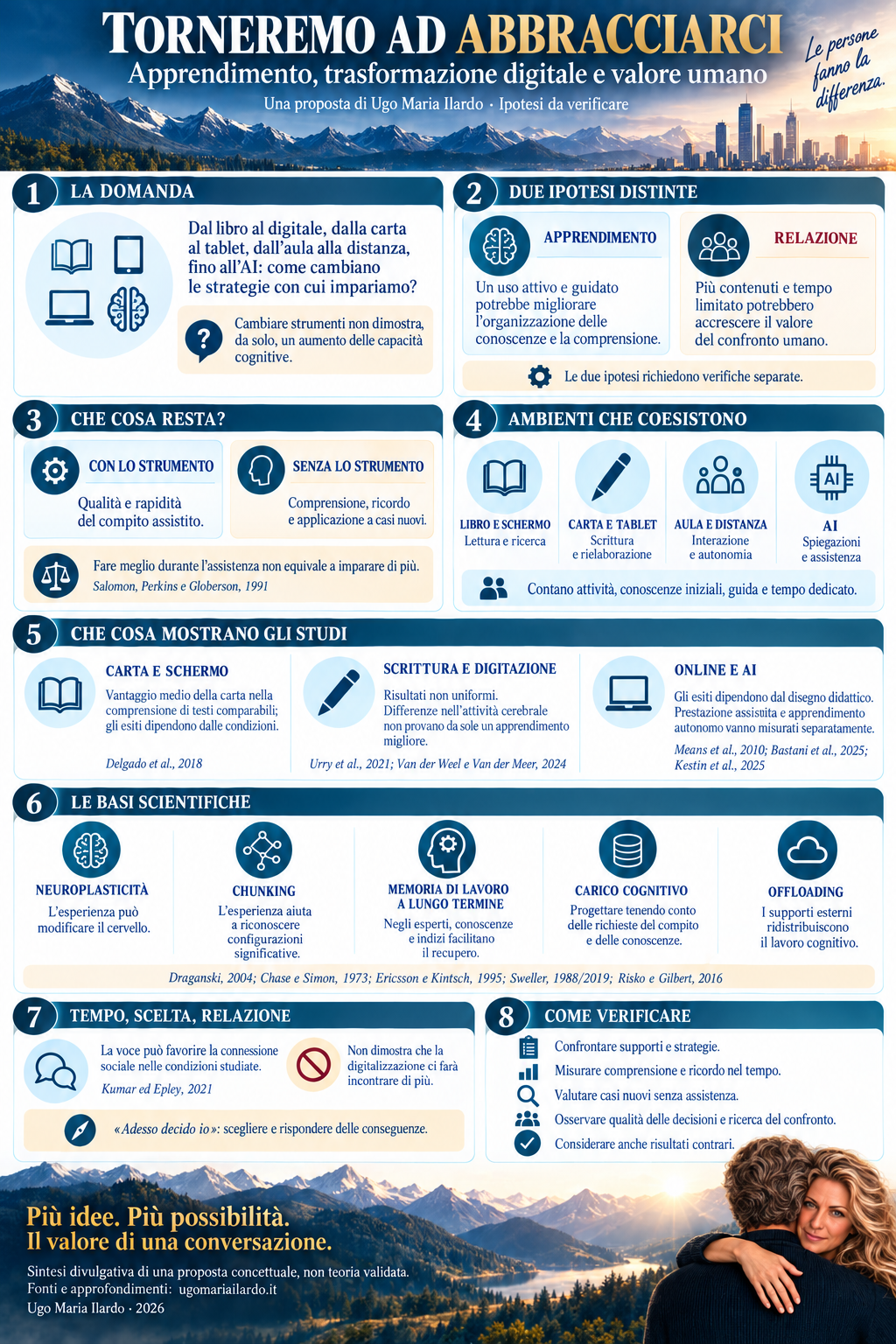
The proposal at a glance
The central question, the two hypotheses, the learning environments and the scientific foundations in one visual summary.
Original infographic in Italian. Full explanations and sources are available in English on this page.
Selected bibliography
Studies, theories and primary sources
A focused narrative overview, rather than a systematic review. The proposal connects research from different contexts: the findings cited do not automatically validate the overall prediction.
- Salomon, Perkins and Globerson (1991). Partners in Cognition. Theoretical proposal. ↗
- Risko and Gilbert (2016). Cognitive Offloading. Review and theoretical framework. ↗
- Delgado et al. (2018). Don't throw away your printed books. Meta-analysis. ↗
- Mayer and Moreno (2003). Nine Ways to Reduce Cognitive Load in Multimedia Learning. Theoretical framework and experimental synthesis. ↗
- Urry et al. (2021). Don't Ditch the Laptop Just Yet. Replication and supplementary analyses. ↗
- Van der Weel and Van der Meer (2024). Handwriting but not typewriting leads to widespread brain connectivity. EEG study. ↗
- Means et al. (2010). Evaluation of Evidence-Based Practices in Online Learning. Meta-analysis and review. ↗
- Bastani et al. (2025). Generative AI without guardrails can harm learning: Evidence from high school mathematics. Randomised field experiment. ↗
- Kestin et al. (2025). AI tutoring outperforms in-class active learning. Randomised trial. ↗
- Draganski et al. (2004). Neuroplasticity: changes in grey matter induced by training. Longitudinal training study. ↗
- Chase and Simon (1973). Perception in chess. Experimental study. ↗
- Ericsson and Kintsch (1995). Long-term working memory. Theoretical proposal and evidence synthesis. ↗
- Sweller (1988). Cognitive Load During Problem Solving: Effects on Learning. Theory, model and experimental evidence. ↗
- Sweller, van Merrienboer and Paas (2019). Cognitive Architecture and Instructional Design: 20 Years Later. Theoretical review. ↗
- Kumar and Epley (2021). It's Surprisingly Nice to Hear You: Misunderstanding the Impact of Communication Media Can Lead to Suboptimal Choices of How to Connect With Others. Experimental studies. ↗
The images are AI-generated representations. The female version of the author is imaginary; the scenes do not depict scientific experiments. Text within the original artwork is in Italian.